Why Tool-Centered AI Learning Leaves You Hollow — and What to Build Instead
This piece challenges the obsession with mastering every new AI tool, emphasizing that problem-solving, system design, and transferable skills outlast any framework. Drawing on real cases, research, and practical advice, it shows how organizations can future-proof their AI capabilities by prioritizing enduring skills over chasing fleeting tool expertise.
Rakesh Arya
8/10/20258 min read

The Illusion of Tool Mastery
A couple of months ago, a friend of mine — someone working at a well-known global bank — asked me,
"Hey, should I use LangChain or LlamaIndex for my project?"
I couldn’t help but smile, because it reminded me of an almost identical conversation a few years back:
"Should I learn TensorFlow or PyTorch?"
And now, here we are again — only this time, the debate has shifted to agentic frameworks. I keep hearing, "What’s better? CrewAI? Autogen? Or maybe that new, fancier thing that just came out last week?"
Here’s the thing most people miss — and I mean really miss.
All the core “agentic” tasks you’re trying to do? You can already achieve them using nothing more than the OpenAI SDK. No fancy framework required. That doesn’t mean frameworks are useless — far from it. They can speed up development, provide structure, and offer built-in features. But making your learning entirely dependent on tools? That’s a trap.
So why do people fall into this trap?
I started looking for an answer, and you know what I found? Job descriptions.
Yes, the way many companies write their JDs almost encourages this mindset. Instead of clearly stating the underlying problem-solving skills they need, they turn it into a contest of “fancy tool listing.” One JD screams for LangChain, another for LlamaIndex, the next for CrewAI — as if the tool is the skill. And when people see this, they chase tools like they’re collecting badges in a video game, believing that’s what employers truly want.
But here’s the irony — most of these tools are interchangeable if you understand the core principles. If you know how to break a problem down, design workflows, integrate APIs, and handle failures, the tool becomes just a means to an end. Isn’t that the real point?
This isn’t me telling you to ignore tools. I’m not anti-framework. I’m pro-problem-solving. The danger is in chasing the mirage of “maximum tool knowledge” while missing the skills that actually endure — the ones that help you adapt when the tool changes, disappears, or gets replaced by something else next quarter.
The Short-Lived ROI of Tool-Only Training
Let’s talk about something uncomfortable — the shelf life of your “tool expertise.”
You know that feeling when you finally master a platform? You’ve gone through the tutorials, you know where all the buttons are, you can even teach a colleague a few tricks. And then, just when you’re feeling on top of the world, the vendor drops a major update. Overnight, your hard-earned mental map of the tool is scrambled. Features move. APIs change. The workflow you perfected? Deprecated.
It’s not just frustrating — it’s expensive.
I’ve seen this play out in organizations more times than I can count. A company invests heavily in training its teams on Tool X. Six months later, a new “must-have” tool appears on the market — one that’s either cheaper, faster, or just better marketed. The leadership team decides to switch. Suddenly, the hours spent mastering Tool X mean very little. The retraining starts from scratch.
One example that comes to mind is a mid-sized financial services firm I worked with. They committed to a high-end AI analytics platform, rolled it out across multiple teams, and even integrated it deeply into their processes. The license costs alone were in the six figures. Less than 18 months later, they moved to another platform because the vendor’s pricing changed and support slowed down. Not only did they eat the cost of the old licenses, but they also had to fund another massive round of training — all while projects stalled.
It’s like buying an expensive, custom-fitted suit and then realizing you have to wear something else entirely for your next big meeting.
The pattern is clear: tools change faster than most organizations can adapt. A report from Gartner in 2024 even warned that “over 60% of enterprise AI investments fail to deliver sustained value due to over-reliance on specific vendor tools.” That’s not because the tools are bad — it’s because the learning was too narrow, too tool-specific, and not built on transferable skills.
When your training is centered around how to click in a particular UI, your ROI has an expiry date. But when your training is about how to think, design, and build — the ROI lasts far beyond the life of any single tool.
And that’s the heart of it, isn’t it? If the goal is long-term capability, why keep building your foundation on shifting sand?
What Organizations Actually Need from AI Skills
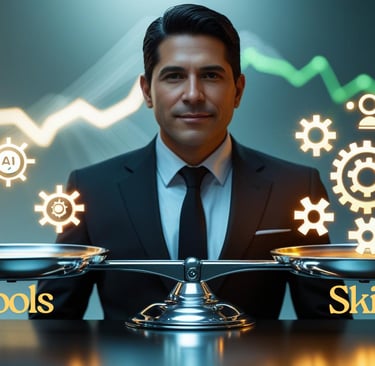
Here’s the truth most job descriptions don’t spell out: organizations don’t really need “LangChain experts” or “LlamaIndex wizards” in isolation. What they actually need is something far more valuable — people who can solve problems regardless of which tool is in their hands.
Think about it like carpentry. A good carpenter doesn’t define themselves by the brand of their hammer. If the hammer breaks, they can pick up another and still build the same table. In AI work, your “hammer” might be LangChain today, LlamaIndex tomorrow, and something else entirely six months from now. But the underlying craft — knowing how to design the workflow, integrate components, and debug problems — is what actually makes you valuable.
When I work with companies, the teams that thrive are the ones with transferable skills:
They know how to integrate APIs, regardless of vendor documentation style.
They understand data preparation so the model has what it needs to perform well.
They can design prompts and workflows that are resilient, so when one service is down, another can step in.
They can handle failures gracefully with retries, fallbacks, and logging — instead of staring at an error screen like it’s a foreign language.
And here’s the key part: these skills scale across tools. If you learn how to chain APIs and handle edge cases in one environment, you can transfer that to almost any other.
One CTO I spoke to recently put it bluntly:
“I don’t care if someone’s never touched our AI platform before. If they understand the fundamentals of building and scaling a system, they’ll be productive here in a week.”
Compare that to a “tool expert” whose skills evaporate the moment they switch platforms — and you start to see why organizations should rethink their hiring and training priorities.
It’s not about learning less — it’s about learning in a way that survives the next wave of hype. Tools are transient. Problem-solving is permanent. Isn’t that the skill worth betting on?
Scaling Beyond the Tool
One of the most common misconceptions I see in organizations is that scaling AI means scaling a tool.
It doesn’t.
Real scaling happens when you can take a successful process and replicate it across new teams, geographies, or product lines — without being locked into one vendor’s ecosystem. The companies that do this well treat tools like interchangeable parts, not like the heart of their system.
My friend worked with a logistics firm that’s a great example of this. Their AI-driven route optimization started with OpenAI’s APIs. A year later, new compliance rules meant they had to store all customer data in-region, which made OpenAI no longer viable for certain workloads. Because their architecture was modular — APIs here, retry logic there, a central workflow engine in between — they were able to swap OpenAI for Anthropic in under two weeks. No panic, no six-month rebuild, no “we can’t work until we learn the new tool” phase.
That’s what scaling beyond the tool looks like.
It’s the difference between:
Scaling with flexibility — where you can replace or upgrade components without breaking the system.
Scaling with dependency — where the whole thing collapses if one part changes.
Frameworks, libraries, and platforms will keep evolving — that’s the nature of technology. The real competitive advantage is designing your workflows so that any single piece can be replaced without derailing the whole machine.
And here’s where it comes back to skills:
If your team knows why each step exists, what it’s doing, and how it connects to the rest, then swapping tools becomes a technical decision, not a company-wide crisis. Isn’t that the kind of adaptability every organization claims to want?
Building Organizational AI Literacy the Right Way
If tool-chasing is the trap, then what’s the alternative?
It’s simple to say “focus on fundamentals,” but in practice, organizations need a deliberate shift in how they train and evaluate AI skills.
The starting point is flipping the order:
Instead of asking, “Which tool should we learn?” start by asking, “What problem are we trying to solve, and what capability does that require?”
That sounds obvious, but in reality, most corporate AI training programs are tool-first. They choose a platform, bring in a vendor to run workshops, and declare themselves “AI-enabled.” The result? Employees learn how to navigate menus and click buttons, but don’t understand why they’re doing what they’re doing.
The organizations that break out of this pattern train differently:
They teach the lifecycle, not just the interface — from data ingestion to preprocessing, model interaction, and result validation.
They build confidence in fundamentals like API calls, data formatting, and error handling, so switching tools doesn’t require starting over.
They create internal playbooks for common AI workflows, so knowledge is documented and repeatable, not just stuck in one person’s head.
One global e-commerce company I know built an “AI Literacy Program” where every training session started with the same exercise:
Here’s the problem. Solve it using whatever tool you want — or no tool at all.
Only after teams understood the problem deeply did they introduce specific tools. The result? Teams that could deliver solutions faster, because they weren’t spending all their time trying to make a tool do something it wasn’t designed for.
And here’s the real payoff: once people understand the why and the how, tools become accelerators, not crutches. They’re used intentionally — and can be swapped out when the business demands it.
That’s the literacy we should be aiming for. Isn’t it better to have people who can think their way through a problem than people who can only follow a vendor tutorial?
A Sustainable AI Learning Roadmap
If there’s one thing the last decade of tech has taught us, it’s that tools will change faster than any of us can predict. What looks “essential” today can become obsolete tomorrow — sometimes overnight. That means the only truly future-proof AI strategy is one built around capabilities, not brands.
So how do you actually do that in an organization?
1. Start with problem domains, not product names
Instead of saying “We’re going to train everyone on LangChain,” say “We’re going to train everyone on how to design and execute retrieval-augmented generation (RAG) workflows.” The problem domain stays constant even if the tools shift.
2. Map skills to business outcomes
Tie your AI learning plan directly to your organization’s goals — customer support automation, faster data analysis, content generation at scale. This keeps training relevant and measurable.
3. Build cross-tool fluency
If your people can design a pipeline in CrewAI, they should also be able to replicate it with OpenAI SDK or Autogen. Rotate tools in training exercises so teams get used to adapting without friction.
4. Document and share internal playbooks
Your AI knowledge shouldn’t live only in the heads of your top performers. Internal wikis, annotated workflows, and reusable code snippets make adaptation possible for the whole team.
5. Bake resilience into every workflow
Teach teams to plan for tool failures, API quota limits, and vendor changes. This is where retries, failovers, and modular design stop being “nice to have” and start being survival tactics.
A manufacturing company I worked with did this brilliantly. They built a training curriculum that mixed core AI skills (prompt design, API chaining, error handling) with “tool rotation challenges” every quarter. When a major vendor changed its licensing model, they swapped platforms in three weeks — without missing delivery deadlines.
That’s what sustainability looks like.
It’s not about predicting the next big framework or memorizing every feature release. It’s about having the mental models, processes, and confidence to adapt — no matter what the AI landscape throws at you.
If organizations can shift their mindset from “learn the tool” to “learn how to solve the problem”, they won’t just survive the next wave of change. They’ll ride it. Isn’t that the real competitive edge?